

This is a profile of Premier Miton. Later this week, I’ll post a follow-up piece looking into valuation and how it compares to the share price. It is the first in a series of profiles and valuations of London-listed asset managers.
The UK Asset & Wealth Management newsletter and website is not investment advice. Please read the disclaimer here.
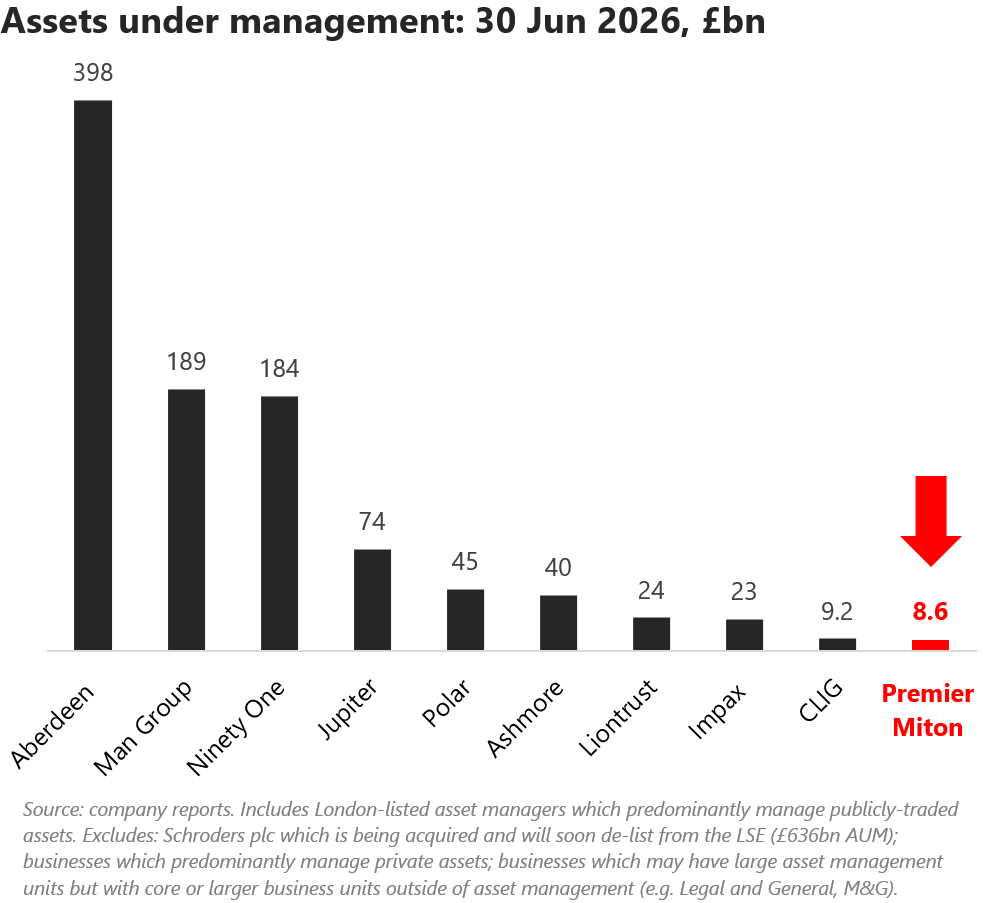
Premier Miton (PMI) is the smallest London-listed, pure-play asset manager.
It offers investors equities, fixed income, multi-asset, and absolute return strategies. Its client base is mostly UK-based.
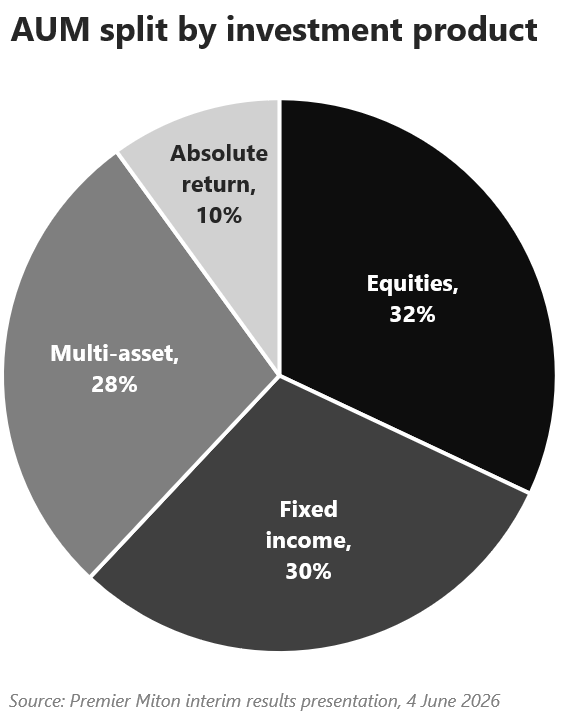
PMI does not disclose an AUM breakdown by client type, but it is predominantly focused on the UK retail intermediated market, with some institutional clients too:
We provide full coverage of the UK wholesale market, including wealth managers, family offices, advisers and platforms.
It’s been a torrid few years, with AUM down 38% from a peak around the end of 2021. This was mostly due to heavy outflows.
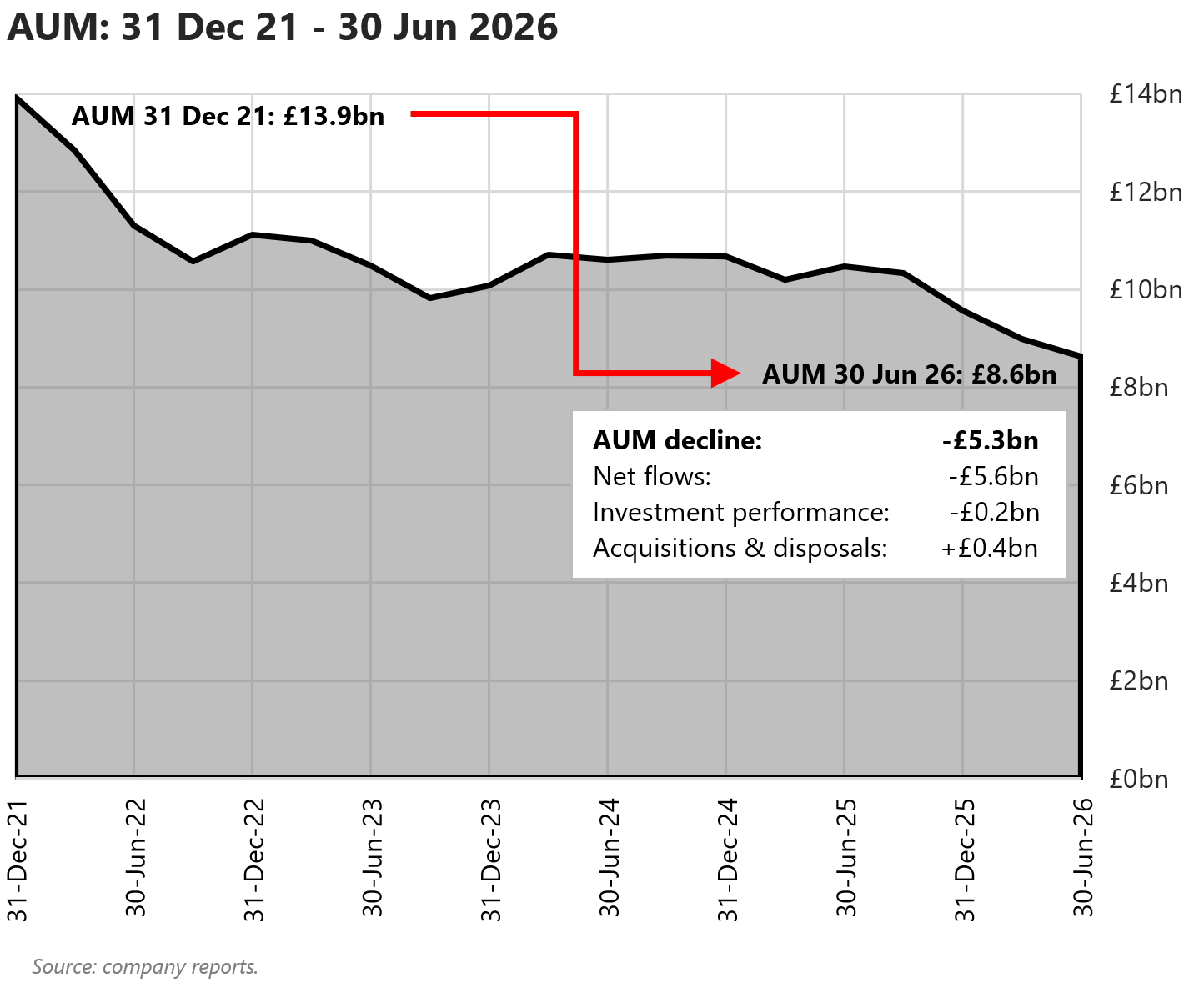
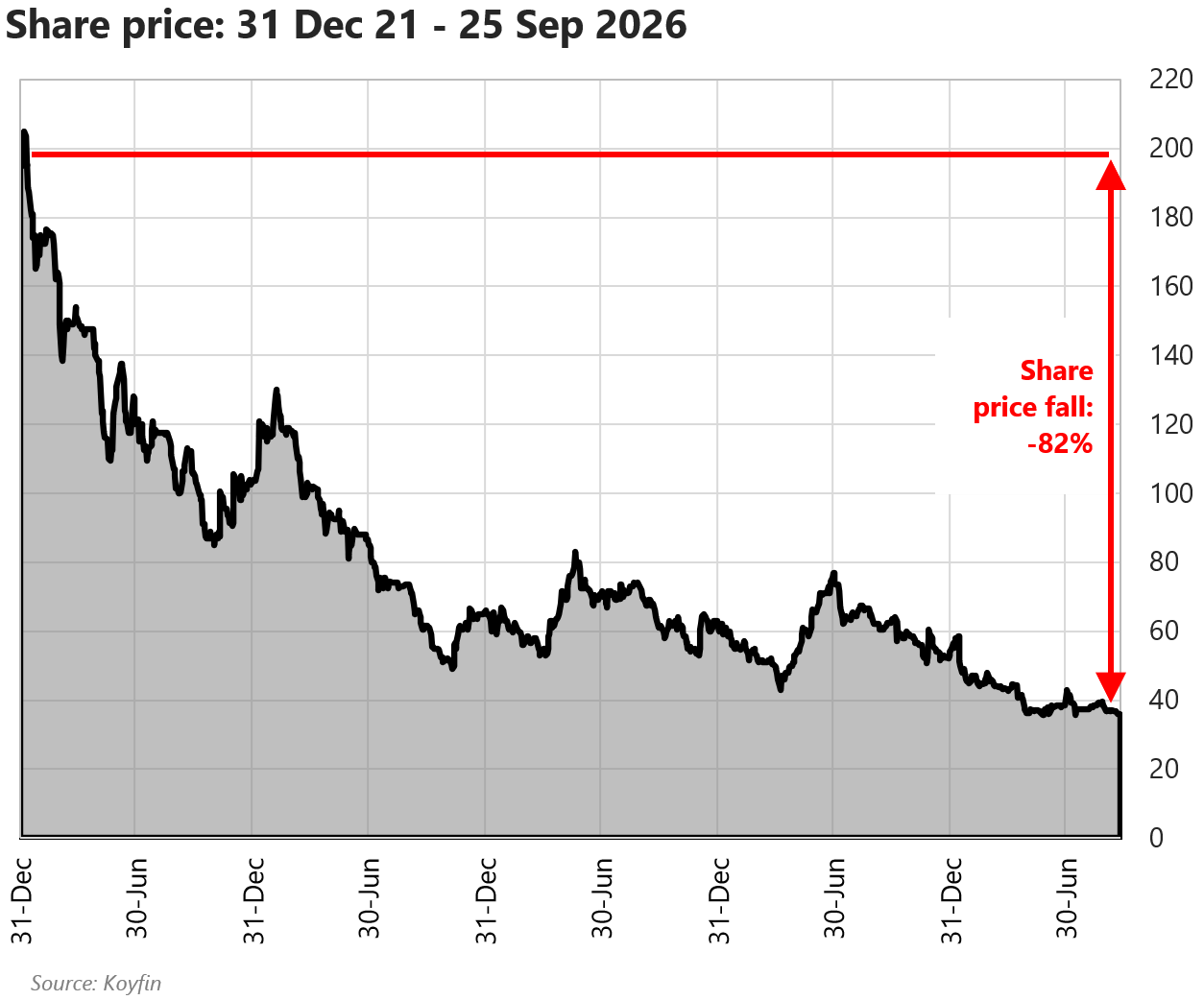
The AUM fall has hit revenue, profits, and the share price, very hard.
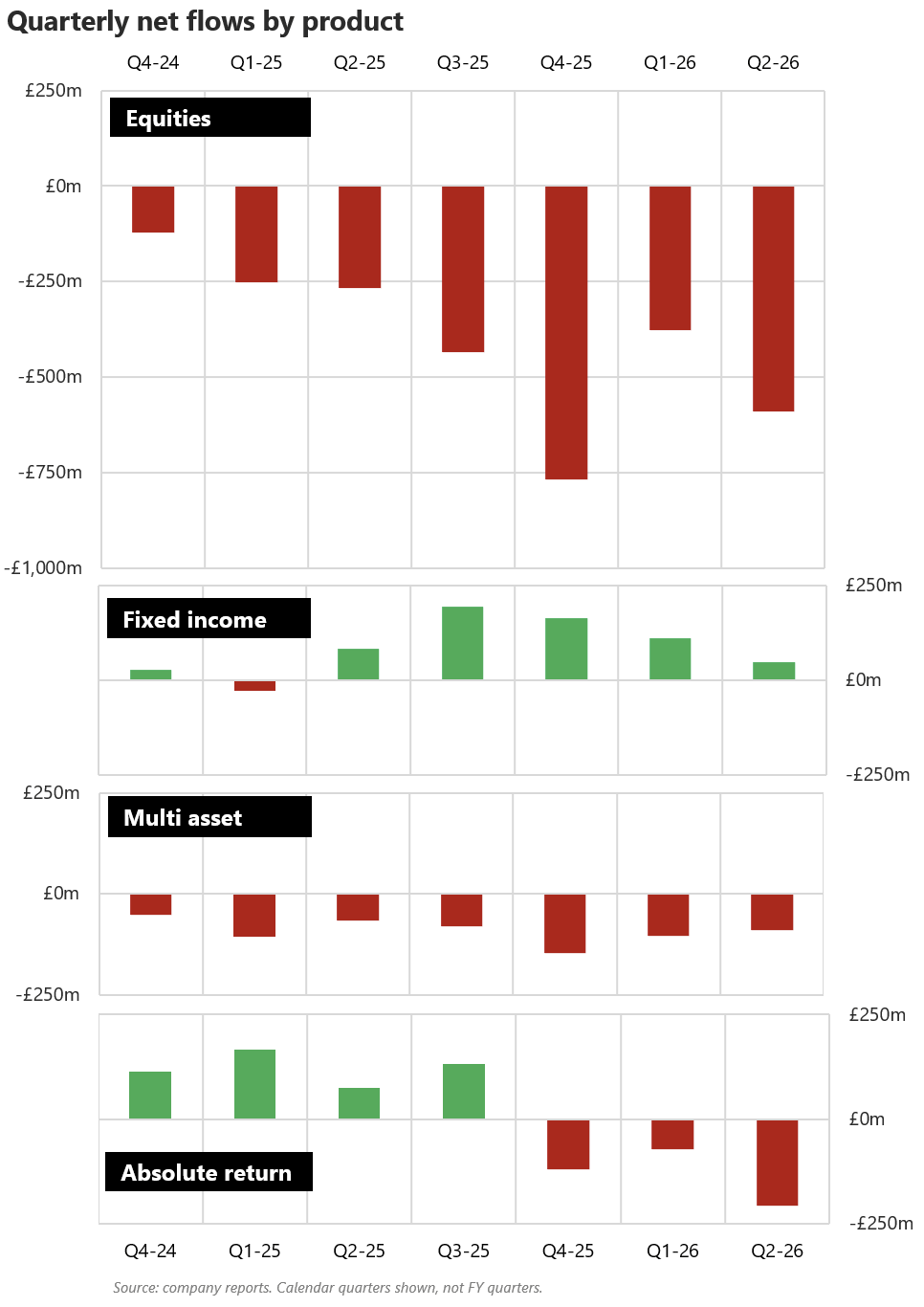
The bulk of PMI’s recent outflow woes are down to its equities strategies, with fixed income the strongest asset class in recent years, consistently attracting positive net flows. Within equities, international equities have been the problem child, accounting for 74% of equities outflows over the period of the chart below. UK equities have contributed 26% of equities outflows.
There are a few key themes to management’s recent actions to tackle the above problems.
1. Cost cuts
Overheads were too high for the reduced AUM base. Around £5m of annual costs were removed in 2025 and early-2026, off an FY24 administration cost base of c. £51m. Another £2.5m of annual cost savings have been identified (announced Apr 26).
Funds have been rationalised (some closed, some merged), headcount has been reduced, supplier costs have been cut, the Guildford office was closed, and some in-house functions out-sourced (e.g. equity trading).
These cost cuts were absolutely necessary, but they are not the answer to the more important strategic issue of returning to AUM growth (actions 2 & 3 below).
2. Improve investment performance, especially in equities
Management have been brutally honest about the need to fix investment under-performance, especially in the international equities space.
“…what has hurt us more recently is the market’s narrow focus on a handful of big tech names, which has been tough for strategies built around mid and small caps. Many clients still believe in what we do, but some have found the relative underperformance hard to live with.” Chief Executive’s statement, FY25 annual report.
While it sounds obvious, management correctly identified that stronger performance is likely to lead to a recovery in flows, and that it had to address this.
It appointed new heads of equities strategies and has said it has taken ‘investment actions’ (according to its H1-26 results presentation), although these actions were not elaborated on. From the FY25 annual report:
Neil Birrell has taken on the role of Head of the Global Equity Team, in addition to his responsibilities as Chief Investment Officer, ensuring strategic alignment across our global investment capabilities.
Paul Marriage has assumed the role of Head of the UK Equity Team. Paul brings deep sector expertise and a long-standing track record, including since joining Premier Miton through the Tellworth acquisition in early 2024.
We’ll have to wait and see if these actions do indeed turn around investment performance - it’s hard to judge in advance if success is likely or not.
3. Lean-in to ‘retirement income’ asset classes
PMI has seen strong demand for its fixed income products and in some areas of multi-asset products. It sees these products as structural opportunities driven by the need in the UK for income-generating products, because of an ageing population.
In addition, it has a strong distribution network in the financial adviser and wealth manager space - which should be significant conduits for these products. Management have said they intend to invest for growth in these areas.
Success won’t be able to offset the problems in equities, but if equity flows do turn around, success in fixed income and multi-asset have the potential to accelerate recovery.
Later this week I’ll be writing about the chances of a return to growth, positive and negative scenarios, the impact of these scenarios on valuation, and where valuation stands relative to share price.
If you haven’t done so already, subscribe to UK Asset & Wealth Management to receive these updates and to keep up to date with the UK asset and wealth management sectors.
And if you think Asset & Wealth Management is worth telling others about and sharing, I’d be most grateful if you do.
Disclosure: At the time of writing, Paul Bryant was a shareholder in a number of the companies mentioned in this publication, and covered Impax Asset Management and Polar Capital as an analyst on behalf of Equity Development Limited. Read Equity Development’s research on these companies by clicking on each. And please read this link for the terms and conditions of reading Equity Development’s research.